

Wednesday, February 4, 2026
The Compounding Loop
The gains compound faster than anyone expected.
There's a scene in The Matrix Reloaded where Neo finally meets the Architect — the program that designed the Matrix. The Architect sits in a room surrounded by screens, and every screen shows a previous Neo. Not possible futures. Past incarnations. Earlier iterations of the same cycle, each one slightly different, each one producing a different outcome.
The Architect has run this process before. Six times. Each cycle informed the next. Each failure taught him something about the system. The screens are showing history — the accumulated results of every previous run.
I keep coming back to this image because it's the best metaphor I've found for what's happening with AI right now.
The Gains Are Compounding
In Cost Per Outcome, I laid out the framework: cost per outcome is the only AI metric that matters. The formula includes prep time, token costs, and review time. The bottleneck isn't AI capability — it's our resistance to changing how work gets done.
But there's something I didn't fully explore: the gains are compounding.
We're optimizing our workflows to work better with AI. At the same time, AI is optimizing its own workflows — mixture of experts, chain-of-thought, self-correction. Both sides are improving simultaneously.
This is why things are moving so fast.
The Two Optimization Paths
When you're trying to reduce cost per outcome, you have two choices:
Path 1: Optimize the steps. Make each phase of the process more efficient. Better prompts. Better specs. Better review systems. Tighter feedback loops. This is careful, methodical improvement.
Path 2: Brute force parallel runs. Don't optimize — just run the process multiple times and average out the errors. Generate ten outputs, pick the best. Let volume compensate for variance.
Both work. The interesting question is when to use which.
For simple work, Path 2 often wins. It's faster to generate five email drafts and pick one than to carefully optimize a single draft through iterations. The selection cost is lower than the optimization cost.
For complex work, Path 1 seems necessary — but Path 2 is catching up. As token costs drop and generation speed increases, "brute force and select" becomes viable for increasingly sophisticated outputs.
The real unlock: combining both. Optimize the steps AND run them in parallel. You get better average quality AND the option to select the best.
The Four Phases
Let me make this concrete. Here's a workflow I've built for software development — and the key insight is that AI generates every phase before it ever writes a line of code.
Phase 1: Raw business context. I talk through what I'm trying to build. Voice notes, rambling explanations, half-formed ideas. No structure required. This is the stop re-explaining yourself principle — capture context once, in whatever form is natural, and let the system work with it.
Phase 2: Structured scenarios. AI transforms that raw context into structured scenarios. "When a user does X, the system should do Y." Clear inputs, clear expected outputs. The messy human thinking becomes precise specification.
Phase 3: Test generation. Those scenarios become unit tests and end-to-end system tests. Not implementation — just the tests that define correct behavior. AI is writing the acceptance criteria before it writes the solution.
Phase 4: Guided code generation. With tests in place, AI generates code that passes them. The tests constrain the solution space. Error rates drop dramatically because "correct" is now precisely defined.
Each phase reduces entropy. Raw thought becomes structured scenarios. Scenarios become tests. Tests guide implementation. By the time we're writing code, most of the ambiguity is gone.
Most people skip straight to "build me this feature." The output is wrong, they iterate on the output, and the cost per outcome stays high. The phases are the trick — use AI to do the thinking work before the building work.
The Pattern Beyond Code
The four phases aren't a software pattern. They're a general-purpose pattern for getting better outcomes from AI:
Raw context → Structured specification → Validation criteria → Guided execution
For content: rambling ideas → structured outline → success criteria ("must cover X, tone should be Y") → draft generation with constraints.
For analysis: raw questions → specific hypotheses → what would confirm/deny each → targeted research and synthesis.
For any knowledge work: start messy, use AI to structure the mess, define what "done" looks like, then generate against those constraints.
The skill here isn't technical. It's the human skill that matters most right now — the ability to break a goal into phases and define success before execution. That's what the 100x solo operator actually does. Not more work. Better work design.
The Loop
Here's where it gets recursive: I use AI at every phase.
AI helps structure my raw thoughts. AI generates the scenarios. AI writes the tests. AI implements the code. My role has shifted from "doing the work" to "designing the pipeline and selecting outputs."
And I'm optimizing the pipeline itself with AI. "Here's my current workflow. Where are the bottlenecks? What would you change?"
Every improvement to my workflow makes AI more effective. Every improvement to AI makes my workflow more powerful. The gains multiply.
This is happening on both sides simultaneously. I'm learning to build more as a full-stack operator. AI is getting smarter — mixture of experts, better chain-of-thought, self-correction. We're both adapting, and the gains compound faster than either side could achieve alone.
Back To The Architect
The Architect didn't build the Matrix once. He built it, studied the results, and rebuilt it. Six times. Each iteration was informed by every previous one. The screens on the wall aren't decoration — they're the compounding loop made visible.
That's the job now. Design the phases. Run them. Study the results. Redesign. Each cycle gets tighter, the cost per outcome drops, and the next iteration starts from a higher baseline.
The question isn't whether you can do this. The tools exist. The question is whether you're willing to stop being Neo — the person doing the work — and start being the Architect — the person who designs how the work gets done.
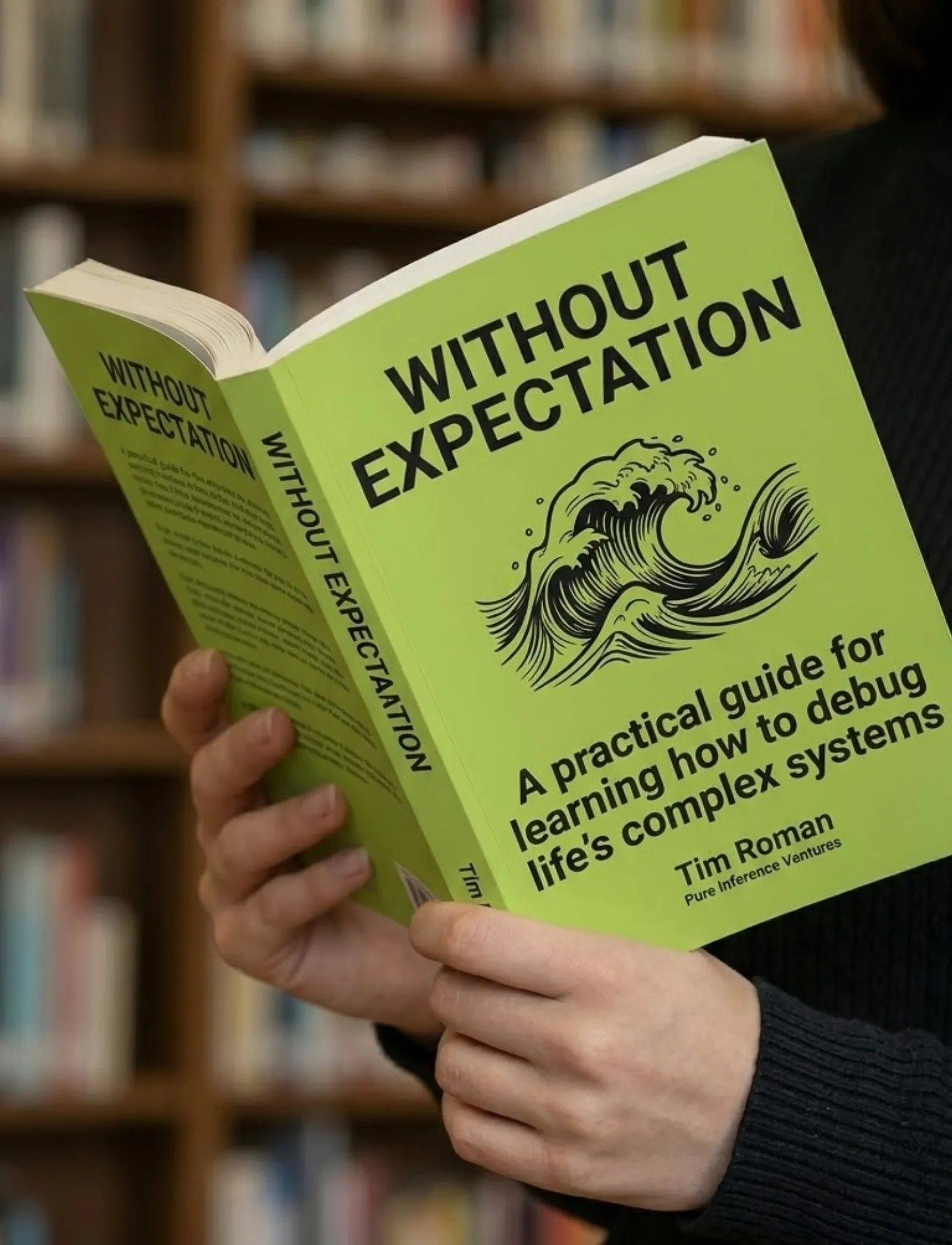
Book & App — Launching September 2026
Without Expectation
Debugging Life's Complex Systems
The same systematic approach engineers use to debug complex systems — applied to the complex system of your life. Learn to observe without judgment, distinguish symptoms from root causes, and run small experiments that compound into massive change.
- 23 chapters
- AI prompt templates
- iOS companion app
- Print, digital & audio
If you liked this, you might also like...

Stop Re-Explaining Yourself to AI
Every session starts fresh. Same context-setting. Same preferences. Same constraints. There's a better way — and it takes one file to fix.

The Compounding Loop for Content
The same four-phase pattern that accelerates software development works for content. Here's how to build a pipeline that turns raw ideas into published work — and compounds over time.