

Thursday, January 22, 2026
The Full-Stack CEO
You're not a specialist anymore. You're a leader of digital workers.
You have a marketing team now. An engineering team. A research department, a design team, operations, finance. They're ready to work. They don't take vacations, don't need benefits, and they're available at 3am when inspiration strikes.
The question isn't whether you have access to this team. Everyone does. The question is whether you're ready to lead them.
This is the full-stack CEO: someone who operates across every function of a business, not by doing everything themselves, but by directing AI specialists who execute on their behalf. Not a specialist who uses AI tools. A leader who manages AI workers.
The shift is profound. For the first time in history, a single person can operate with the functional breadth of an entire organization.
The CEO Mentality
Think about what a CEO actually does. They're not experts in every function — they're cross-functional leaders. They know enough about marketing to direct a CMO, enough about engineering to challenge a CTO, enough about finance to hold a CFO accountable. Their job is knowing what questions to ask, setting direction, and orchestrating specialists toward a common goal.
That's the mindset required now.
Not expertise in everything. Competence in directing. Enough experience in each area to know where the blind spots are, what good output looks like, and when something's off. This threshold is lower than people assume — a few months of active work in any domain builds enough intuition to lead effectively.
The specialists on your staff are AI. Your job is motivating them to perform at their peak, getting them to verify their work, and orchestrating them to work well together. Same leadership skills. Different kind of team.
Breadth Over Depth
Twenty years of career advice said specialize. Go deep. Become the expert.
That advice is inverting.
Breadth is now paramount for utilizing the full capacity of AI. The generalist who knows something about product, design, engineering, and operations can direct AI specialists in all four areas simultaneously. The deep specialist in one domain can only leverage AI in that one domain.
The multiplication favors breadth. If AI gives everyone 10x leverage in their area of competence, the person competent across ten areas gets 100x total capability. The person expert in one area gets 10x in that area and nothing elsewhere.
This doesn't mean expertise is worthless. It means the returns on breadth have changed. Every additional domain you understand — even at a basic level — is another team you can lead.
Leading Through Constraints
AI has a weakness that matters: it defaults to complexity. Given an open-ended problem, it will over-engineer, over-abstract, and optimize for scenarios that will never happen. It suffers from analysis paralysis when humans would just make a decision and move.
This is where leadership comes in.
Humans always design with constraints — budget, timeline, technical ability, existing commitments. AI doesn't know these constraints unless explicitly told. The full-stack CEO's job is providing that context: what matters, what doesn't, where the boundaries are.
This means making decisions upfront and encoding them:
Design direction decided early. UI systems, component libraries, brand guidelines — chosen and documented before execution begins. The AI works within the system instead of reinventing one for every task.
Architectural opinions documented. Technology choices, platform preferences, integration patterns — decided once, written down, never re-litigated. Templates that new work inherits so the AI operates within established constraints.
Your own limits as valid input. The biggest constraint is often your own technical ability or available time. A platform you know deeply beats a theoretically superior option you'd have to learn from scratch. This is legitimate direction. Give it.
The pattern: lead by providing constraints, context, and clear expectations. Then execution becomes fast and consistent.
Where Human Leadership Remains Essential
The full-stack CEO model handles execution across every function. It doesn't handle everything.
Blind spots are real. Without other humans providing perspective, it's easy to miss what you don't know you're missing. AI can research and analyze, but it can't tell you "you've been avoiding the hard problem" or "this direction doesn't feel right."
Accountability remains human. The discipline of focus, the emotional weight of decisions, the judgment of where to invest limited time — AI can assist but can't own these. They require human self-awareness and human relationships.
There's a red line. AI augments human capability but shouldn't replace human experience and connection in areas that require them. The full-stack CEO needs advisors, collaborators, and people who will push back. The AI team handles execution. The human relationships handle everything else.
The Starting Point
Someone watching this shift, wondering how to begin — here's the question:
If you could hire someone right now, what would they do?
What tasks feel like drudgery? Where do you waste time on things you're mediocre at because you don't enjoy them? Everyone has aspects of their work that feel like obligation and aspects that feel like opportunity.
AI tips the balance. The full-stack CEO isn't doing more work — they're doing more of the right work. The parts that require human judgment, creativity, and taste. Everything else gets delegated to the team.
Start with what you'd hand off. Get competent enough to direct that function. Then direct it.
The Opportunity
Satya Nadella shared recently that Microsoft added $90 billion in revenue over four years with flat headcount. LinkedIn collapsed product managers, designers, and engineers into unified "full-stack builders." The structural shift is already happening at the highest levels.
But this isn't just about enterprise reorganization. It's about individual capability.
For the first time, a single person can operate across every function that matters. Marketing, product, engineering, operations, finance — all accessible through AI workers ready to execute. The limiting factor isn't access to talent or capital. It's whether you're ready to lead.
The full-stack CEO isn't a job title. It's a way of operating. Cross-functional. Generalist. Leading through direction rather than doing through expertise.
The team is assembled. The question is whether you'll step into the role.
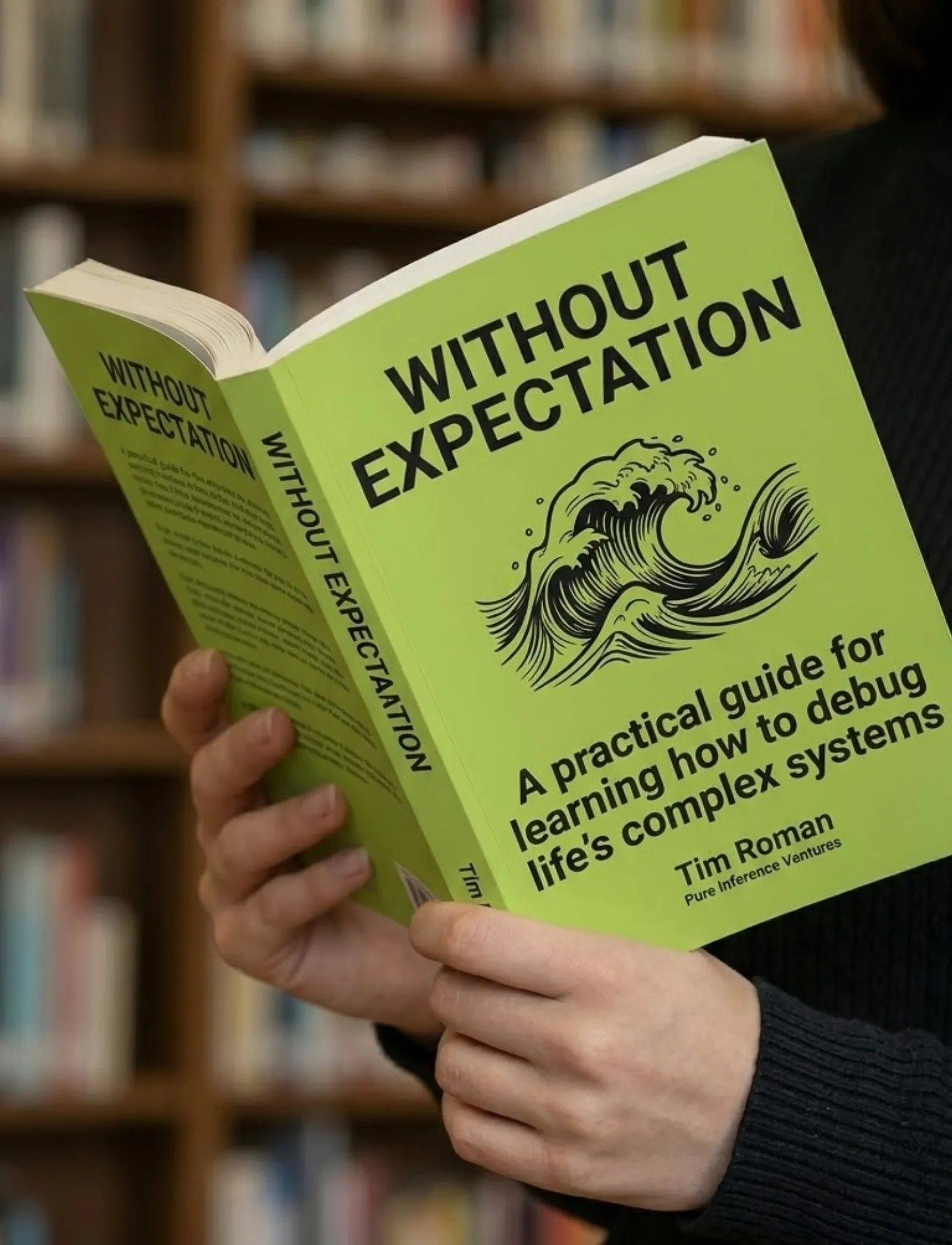
Book & App — Launching September 2026
Without Expectation
Debugging Life's Complex Systems
The same systematic approach engineers use to debug complex systems — applied to the complex system of your life. Learn to observe without judgment, distinguish symptoms from root causes, and run small experiments that compound into massive change.
- 23 chapters
- AI prompt templates
- iOS companion app
- Print, digital & audio
If you liked this, you might also like...

The 100x Solo Operator
The 100x developer is a meme. The 100x solo operator is a business model. Here's what it actually looks like to run a company with AI as every department.

Your Moat Is Your Domain
AI is democratizing technical ability at unprecedented speed. The new competitive advantage isn't coding skill—it's understanding what to build and why it matters.