stir
sleep sounds & wake up
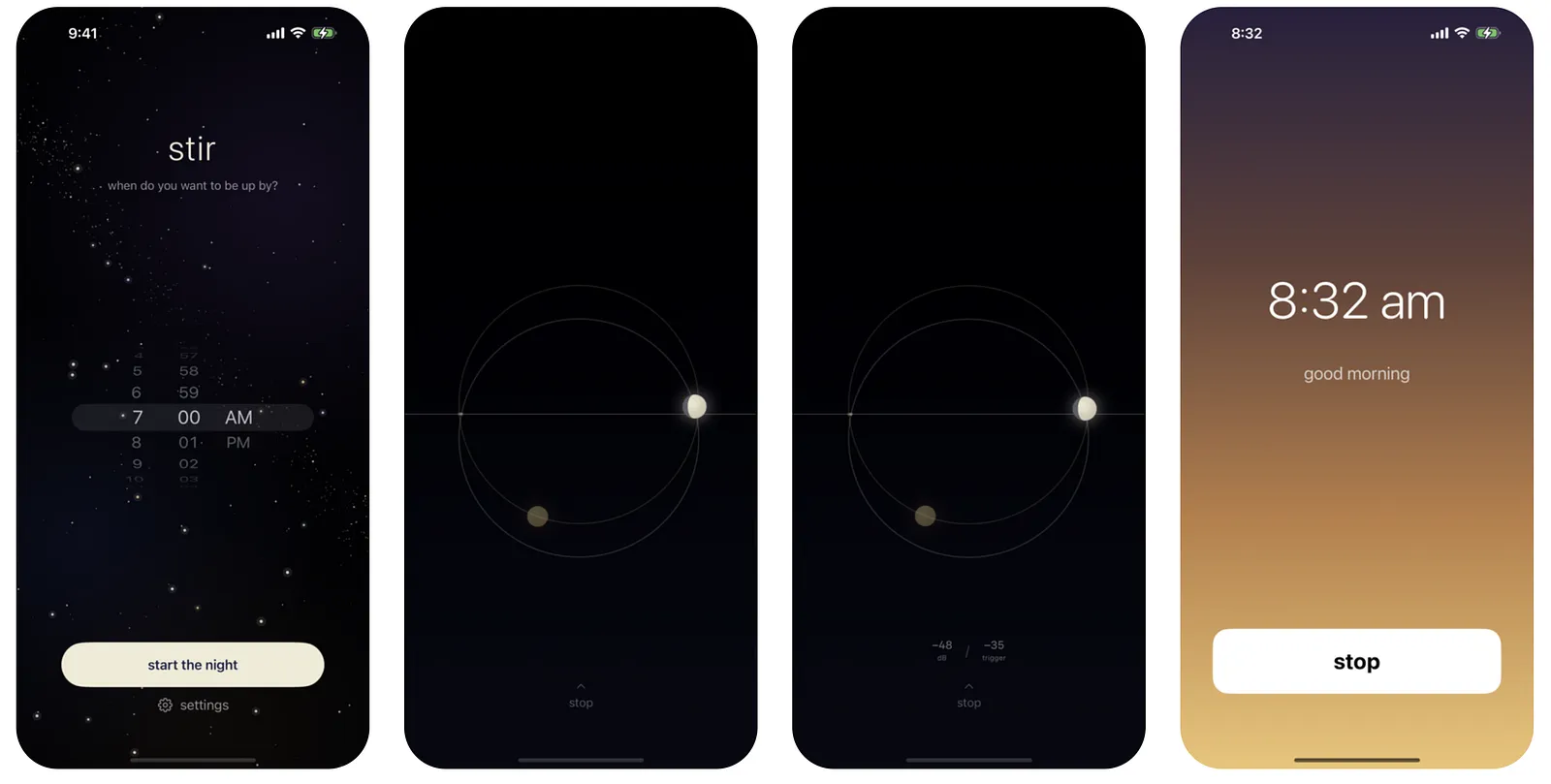
stir covers the whole night with one setting: the time you need to be up by. White noise carries you to sleep (white, pink or brown noise, a fan, wind or ocean waves) and fades to silence before morning. Then stir listens, calibrated to your room, so distant traffic never wakes you but the rustle of you stirring does, and it wakes you gently inside your wake window. Miss the window and the alarm sounds at your “up by” time no matter what, with sound and a gold light rising together over a minute.
The night screen shows nothing that tells the time: no clock, no countdown, no status bar. What’s there instead is a black sky with the real sun and moon on their daily rings, computed on the phone. When the moon touches the horizon line on screen, it’s rising or setting outside your window.
How it’s built
Swift and SwiftUI, iPhone only, and everything runs on the phone: no accounts, no analytics, no servers. Detecting stirring is signal processing, not a model. When the wake window opens, stir measures the room for thirty seconds to learn its baseline, then wakes you when sound stays above it by a margin you set, or when the phone moves. The microphone is only used during the window, and nothing is recorded. On iOS 26, a system alarm set just after your “up by” time backs it up, so it still fires in Silent mode or with the app closed. The sounds are synthesized, not licensed.
Getting it right took most of a year of nights: loops that dipped at the seam until they were crossfaded, brown noise that was silent on a phone speaker until the low bass was filtered out, an alarm silenced by the haptics engine, and an App Review rejection before approval.
It went live on the App Store on September 7, 2026. It’s free and open source. When software costs this little to make and keep running, a simple useful tool doesn’t need a subscription behind it.