10,600 Trajectories: Mutation Testing in a Video Game
Every Kepler mission is validated by ten thousand simulated flights before it ships

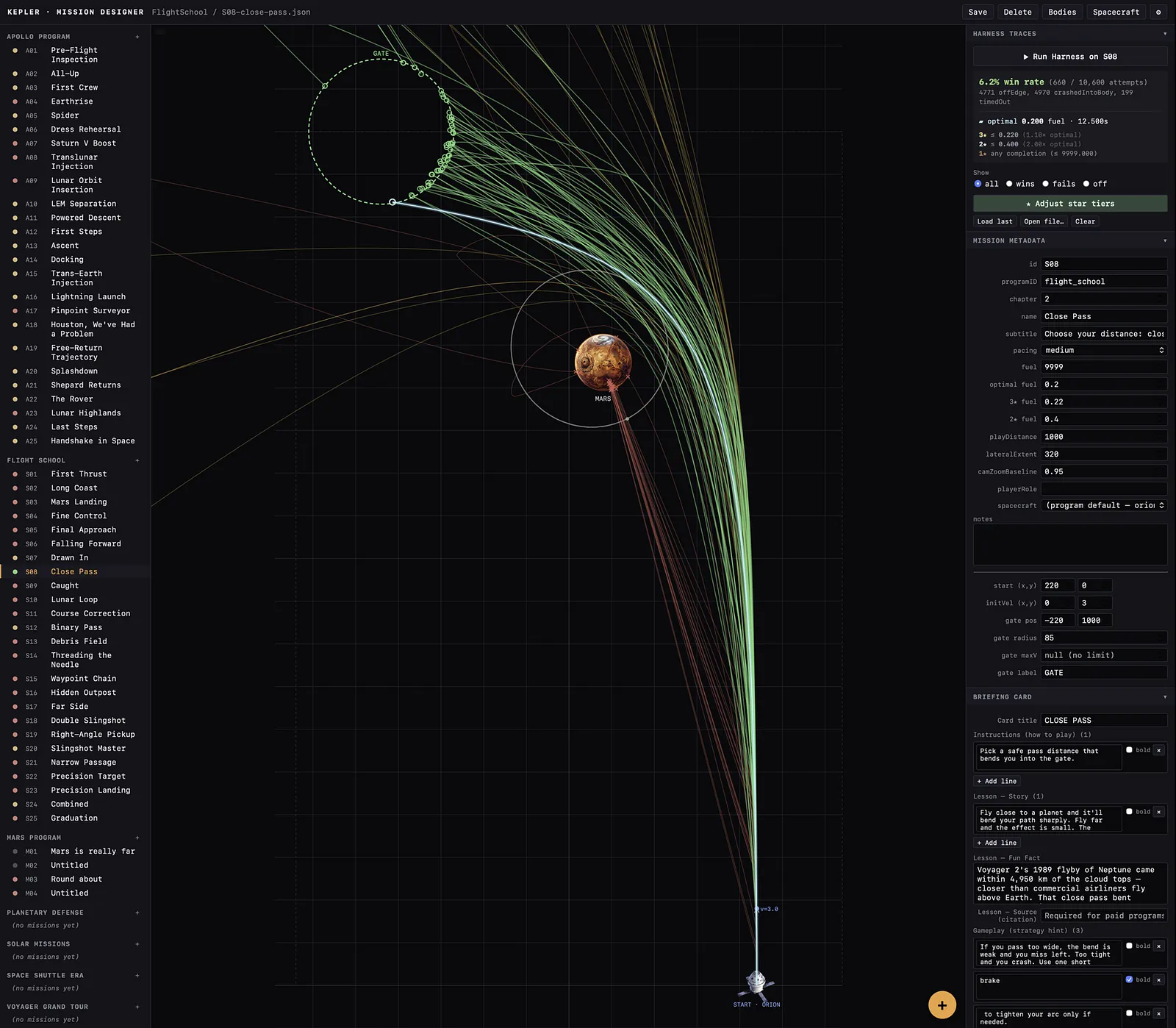
10,600 attempts. 660 made it. The rest crashed into Mars, drifted past the boundary, or ran out of clock. This is the only test we have for whether a Kepler mission actually works — and it’s the same shape of work the people designing real spaceflight do.
Two phases, two questions
The harness runs in two phases, asking two different questions of the same mission.
Random sampling runs first — thousands of flights with randomized brake timings. Most miss; the green lines are the rare random successes, the rest drift past the play boundary, crash into Mars, or run out of clock. Sampling measures the width of the corridor: how forgiving the mission is to imprecise input.
Beam search runs next — a directed search for the cheapest fuel cost that completes the mission. The cyan line is what it converges on. Beam search measures the floor: the best a perfect player could ever do.
Together they answer one question phrased two ways: does this puzzle deserve to ship? Mission S08 Close Pass — the one in the picture — landed at 6.2% with optimal fuel of 0.200 over 12.5 seconds. Star tiers cascade from there: three stars at 1.1× optimal, two at 2×, one for any completion.
Why this matters for a solo builder
A studio with twenty playtesters can brute-force this. They run people through every mission for a week and trust the survivor pool. We can’t. What we can do is automate the same question and run it ten million times.
This is what mutation testing looks like in the form of a video game. It’s a core premise that enables agentic software engineering. You don’t just tell it what you want and hope it builds something that works — you specify boundaries and outcomes, then turn the agent loose. It finds the optimal solution; it doesn’t magically create it. Automated testing guides development, ensures accuracy, and prevents regression.
The most overhyped use of AI tooling right now is generation — code that types itself, copy that writes itself, art that draws itself. The most underrated is search. A solo builder doesn’t need a magic wand; a solo builder needs the reach a studio gets from headcount. The harness gives us that reach. Every mission gets the scrutiny a 25-person QA team would have given it — at scale, deterministically, without ego.
The right win-rate band shifts by chapter, by design. Chapter 1–2 lessons should run wide — 20–50% — because they’re teaching, and the corridor has to absorb wrong inputs. Chapter 4–5 capstones run tight — 0.5–5% — because they’re demanding integrated mastery. S21 Narrow Passage, the Chapter 5 capstone, hit 0.035% on a recent harness run: 5 wins out of 14,321 attempts. Exactly where a final exam should sit. We didn’t tune that by playtesting; we tuned it by running the harness, reading the band, adjusting, and re-running.
Why this matters today
Earlier this year, a cosmologist in Brazil published a set of Earth-to-Mars trajectories that could cut a round trip from nearly three years to about five months. He found them in a domain humans have simulated for sixty-plus years, and he found them by accident — he was studying asteroid orbits and was not looking for this at all. The geometry had been sitting in the imprecise early orbit of a single asteroid, in exactly the data that gets thrown away once better measurements arrive.
Read that again. Sixty years of simulation. Thousands of careers, billions in computer time. And the ground is still moving. The frontier of things we know isn’t slowing down — it’s accelerating, in places we thought were settled.
That’s the world kids growing up now will inherit: a moving target, where memorizing settled facts is the wrong instinct because settled facts don’t stay settled. The right instinct is the one the harness has, the one the Mars researcher had, the one a kid sitting on the couch with Close Pass develops without realizing it — search the space, notice the pattern in the failures, find the spots no one has checked.
What a kid is doing at the iPad
A kid playing Close Pass doesn’t know they’re running a harness in their head. They know I went too close that time and let me try farther out. Sample size of however-many-tries; convergence by feel; eventually a clean win at something near optimal — because gravity is gravity, the corridor is real, and the method works.
That’s not gaming. That’s the same loop the harness runs. The same loop the Mars researcher ran. The same loop every problem-solver runs. The game teaches the shape of how problems actually get solved — not the answers, the method.
The educational angle isn’t an afterthought; we always wanted Kepler to feed a kid’s curiosity about math and physics. What surprised us is how much of the teaching happens at the level of method rather than content. The harness exists for engineering reasons. The fact that it teaches the same engineering instinct to the player — in miniature — wasn’t designed in. It fell out.
10,600 trajectories. 660 wins. One kid, one iPad, one game that takes its job seriously. That’s why we built this.
Keep reading
- The Undocumented iOS Limit That Rewrote My Architecture Pure Inference I needed two concurrent speech recognition streams. Apple's docs don't mention you can't have them — the second start silently kills the first.
- Designing a Test Runner for AI Agents Pure Inference Seven stuck Ruby processes, running for hours, holding database connections. The agent that spawned them had moved on, oblivious.
- Structure Over Prompts Pure Inference Everyone's building AI agents to orchestrate AI agents. I built a state machine instead. Zero orchestration tokens, no hallucinated transitions.
- 'I was not looking for this': Scientist accidentally finds shortcut to Mars that could slash travel time in half Sharmila Kuthunur, Live Science · 5 May 2026 The Mars result in full: how a cosmologist found a 33-day Earth-to-Mars trajectory in the imprecise early orbit of an asteroid, in data that gets discarded once better measurements arrive.